08.12.2025 Piloting of the Open University Study Format and New Study Modules at the Branch of the Technological University of Tajikistan in Isfara (BP5 TUTI)
Section outline
-
-
The piloting of the Open University study format and newly developed study modules was carried out at the Branch of the Technological University of Tajikistan in Isfara (BTUTI), with the support of professors from the Latvia University of Life Sciences and Technologies and the Slovak University of Agriculture in Nitra.
Two study modules: “Fruit and Vegetable Processing Technologies” and “New Food Product Development” were tested at the BTUTI during the period from 15 September to 5 December 2025.
From 8 to 11 November 2025, LBTU professors Dace Klava, Evita Straumite, and Liene Ozola delivered lectures and conducted practical and laboratory sessions focusing on fruit and vegetable processing technologies, therefore supporting the BTUTI staff. They demonstrated modern processes and approaches for innovative food product development. SUA professors Eva Ivanisova and Oleg Paulen provided remote lectures on food innovation, alternative food sources, properties and peculiarities of different fruits as factors influencing postharvest management and processing. The piloting process was made possible through the use of new equipment acquired within the OFINU project.
BTUTI teachers and students actively participated in the lectures and practical sessions. Representatives of local fruit processing companies from Isfara and the region joined the study process in the capacity of external learners. In addition, representatives from other OFINU partner institutions - the Andijan Institute of Agriculture and Agrotechnology (Andijan), Samarkand Agroinnovations and Research University (Samarkand), the Technological University of Tajikistan (Dushanbe), and the University of Innovation and Digital Technologies of Tajikistan (Kulob) took part in the piloting activities.
On 11 November 2025, a site visit to the food enterprises was conducted. At the dried fruit processing enterprise LLC “Fruit Valley”, guests were welcomed by the enterprise director, D. Saifulloev, and the commercial director, L. Ortuqov. During the visit, guests observed the fruit kernel processing line and their preparation for export. Afterwards, the students and researchers visited the preliminary processing and packaging units for dried fruits. According to the enterprise managers, their products are exported to the United States, Europe, Kazakhstan, and partially to the Caucasus. Apricot kernels are mainly exported to confectionery enterprises in Germany.
Guests were welcomed also by LLC “Subhi Vatan”, producing mainly canned fruit and vegetable products from local raw materials. The chief technologist, Abduvohidov Abduqahhor, introduced the guests to the technological processes. Guests highly appreciated the products’ taste. It should be noted that BTUTI students undergo practical training at the enterprise annually. Several graduates are currently employed as experienced specialists. The enterprise’s products are mainly export-oriented, with consumers predominantly in CIS countries, Germany, and the Baltic States.
Later, academic staff and students visited LLC “Golden Fruit”. Guests were warmly welcomed by the director, Khairullo Rizoev. Visitors had an opportunity to acquaint themselves with both main areas of the company: dried fruit and vegetable processing, and cardboard packaging production. Various types and sizes of packaging, their uses, and the relevant machinery were demonstrated at the cardboard packaging production facility. At the dried fruit and vegetable processing section, visitors observed the technological processes and equipment. The enterprise is fully export-oriented, with its consumer market extending beyond CIS countries to European countries, Japan, and Korea.
At the end of the day, guests visited LLC “Isfara Food”, an enterprise specialising in the export of dried apricots. Besides the production part, visitors were acquainted with the laboratory, the methods, and equipment used for testing of production. The laboratory measures moisture content, weighing scales, as well as tools for determining sulfur content in apricots.
Besides practical insights into real food production processes, participants got positive and lasting experiences.
The piloting aimed to validate both the teaching methods and the content of the study modules, ensuring their quality and suitability for future implementation.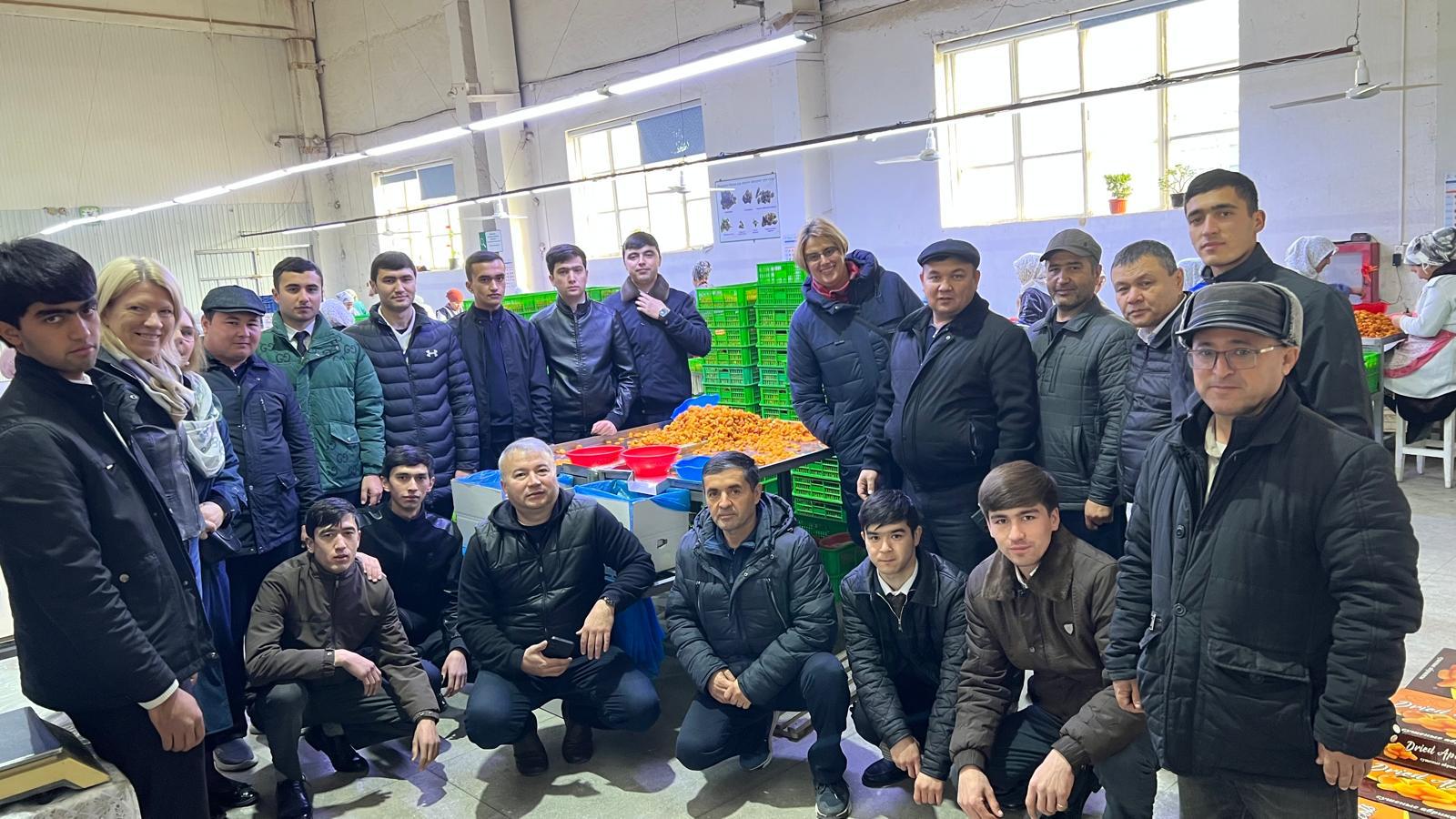
-